
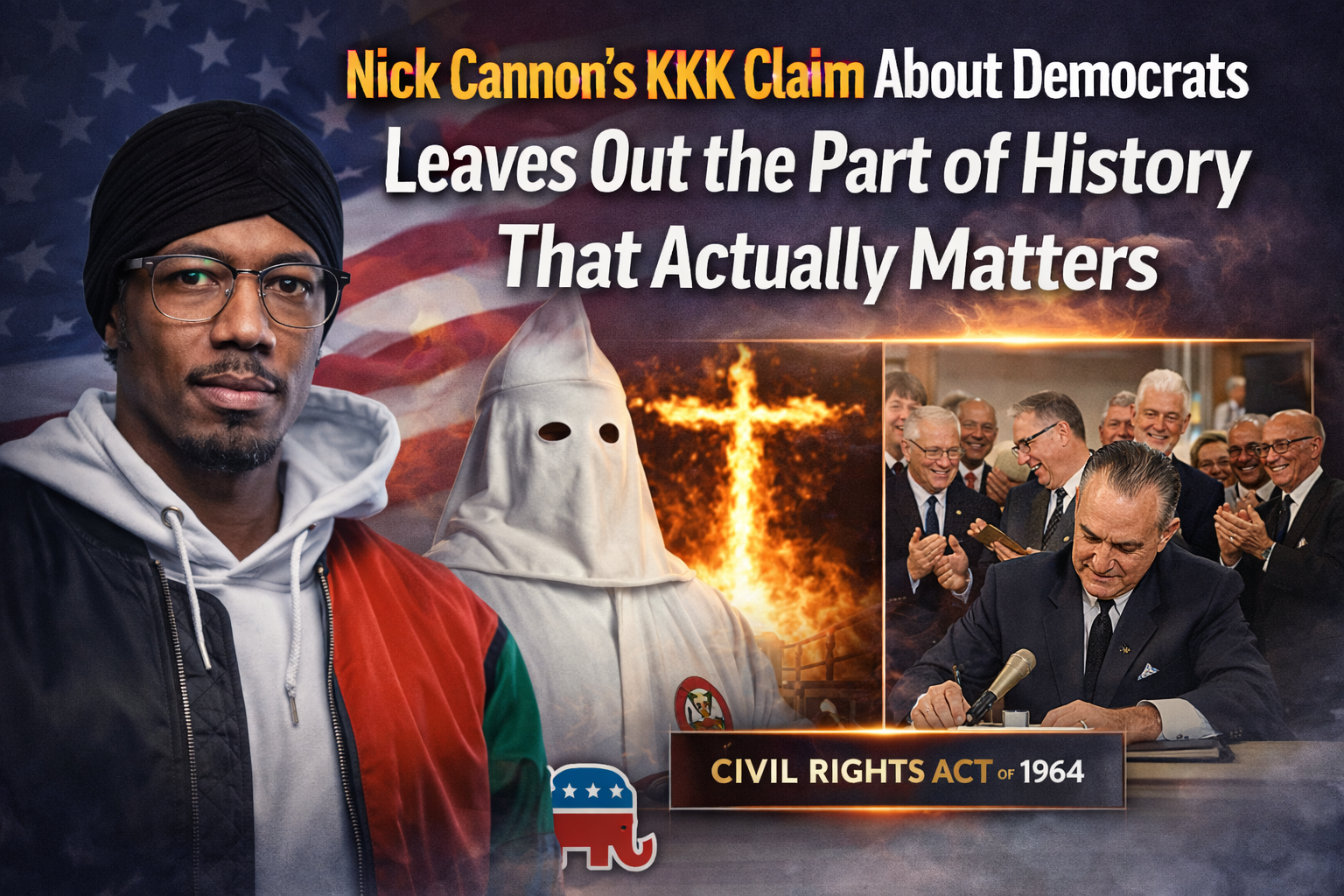
Nick Cannon stirred backlash after saying Democrats are “the party of the KKK,” agreeing with Amber Rose on a March 2026 episode of Big Drive, and adding that Republicans were “the party that freed the slaves.” He also said he does not fully subscribe to either party, while still praising Trump and saying, “I f— with Trump.” Multiple outlets reported the same remarks from that episode. (Fox News)
The first problem with Cannon’s argument is that it takes a piece of 19th-century history and pretends nothing changed after that. It is true that the original Ku Klux Klan emerged during Reconstruction as a white supremacist terror group resisting Republican-led efforts to expand rights for freed Black Americans. It is also true that the 19th-century Republican Party was the party of Lincoln and emancipation. But stopping the story there is misleading, because the two parties did not stay frozen in those roles. (HISTORY)

That missing piece is party realignment. Over the 20th century, and especially around the civil rights era, the national Democratic Party moved toward civil rights, while many segregationist white Southern voters shifted toward the Republican Party. Britannica describes the Republican “Southern strategy” as a campaign strategy actively pursued from the 1960s to win white Southern voters, initially by subtly endorsing segregationist and anti-civil-rights sentiment. That does not erase the Democratic Party’s ugly history in the 1800s and early 1900s, but it does destroy the lazy talking point that present-day politics can be explained with one sentence about who was who in 1865. (Encyclopedia Britannica)

The record around the Civil Rights Act of 1964 makes that shift hard to ignore. The National Archives notes that Southern Democratic opponents tried to kill the bill with a filibuster, while the Senate needed substantial Republican support to break that filibuster and pass the law. That means the vote was not a simple “Democrats bad, Republicans good” story. It was more regional and ideological than that. But it also shows that the Democratic Party of the civil rights era was no longer the same political force as the pro-segregation bloc Cannon’s line points to. (National Archives)
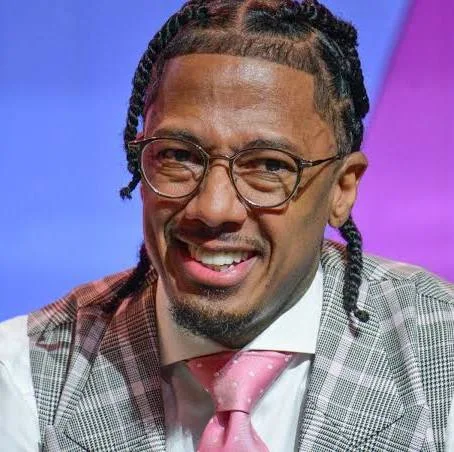
That is why Cannon’s claim falls apart as a modern political argument. Yes, Democrats once housed many segregationists. Yes, the KKK had deep roots in the post-Civil War South. But using that old alignment to tell people the modern Democratic Party is therefore “the party of the KKK” skips over the Civil Rights Movement, the Dixiecrat split, the collapse of the Solid South, and the Republican Southern strategy. Leaving those parts out is not truth-telling. It is cherry-picking. (Encyclopedia Britannica)
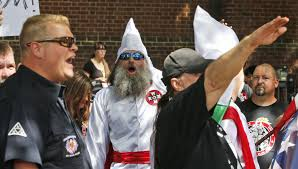
There is another reason this kind of claim deserves pushback: it turns Black history into a cheap slogan. The KKK was not just a bad club with the wrong party label. It was a terrorist organization that used murder, rape, and intimidation to crush Black political power during Reconstruction. Reducing that history to a gotcha line for cable-news style politics is a disrespect to the people who actually suffered under it. (Federal Judicial Center)

If Cannon wants to argue that Democrats fail Black voters today, that is a real political debate and he is free to make it. He can criticize economic policy, policing, education, housing, or campaign promises. But that is different from using a half-true historical fragment as if it settles the question. Serious political criticism should be built on current policy, measurable outcomes, and complete history, not a recycled talking point that depends on people not knowing what happened after Reconstruction. (EW.com)
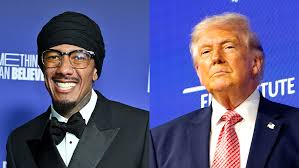
So the clean factual bottom line is this: Cannon is repeating a claim that contains a narrow historical truth but leaves out the larger history that makes the claim misleading in the present day. The early KKK did emerge from white Southern resistance linked to Democrats of that era. The early Republican Party did lead emancipation. But modern party coalitions were reshaped by civil rights politics, and historians widely treat that realignment as central to understanding race and party in America now. (HISTORY)

Nick Cannon’s comments and reporting: (Fox News)
KKK and Reconstruction history: (HISTORY)
Party realignment and Southern strategy: (Encyclopedia Britannica)
Civil Rights Act context: (National Archives)

Related Articles
Latest Articles
-
Hip-Hop Must Speak Up: Why the 2026 Midterms Are About Justice, Safety and Survival
The hip-hop community has a powerful voice in America. Hip-hop is no longer just music. It is a culture, a way of life and one of the most influential ways to reach the masses. From its beginning, hip-hop has told stories about poverty, policing, inequality, racism and survival. It gave a microphone to communities that…
-
Trump Plan to Cut Federal Workforce : Why Critics Are Sounding the Alarm
The push to cut the federal workforce is being sold as bold leadership and fiscal responsibility—but when you actually break down the numbers, it starts to look more like political theater than serious economic policy. Honestly, this is just dumb. Let’s be clear: the total U.S. federal budget sits around $6–7 trillion annually. Federal civilian…
-
Jay Z & Roc Nation Got This One Wrong: Battle Rap Still Moves the Culture
When jay z nation starts acting like battle rap is some dirty part of hip-hop we should leave behind, I gotta push back. Nah. That take is too soft, too clean, and too far removed from what this culture really is. Jay-Z said in his March 2026 GQ interview that he does not know if…
-
Nick Cannon Said Democrats Are the Party of the KKK. Here’s What History Really Says
Nick Cannon stirred backlash after saying Democrats are “the party of the KKK,” agreeing with Amber Rose on a March 2026 episode of Big Drive, and adding that Republicans were “the party that freed the slaves.” He also said he does not fully subscribe to either party, while still praising Trump and saying, “I f—…
-
Iran’s New Demand Could Reshape the End of the War
Iran has a new demand to end the war and it should not be brushed off or ignored. It is a clear warning that this whole situation is getting worse, not better. Iran is no longer just reacting—it is setting the terms. Reports show that Iran has rejected U.S. ideas and is now making its…
-
ICE at Airports: What Travelers Need to Know
✈️ What “ICE in the Airport” Means ICE (U.S. Immigration and Customs Enforcement) is a federal law enforcement agency under the Department of Homeland Security that enforces immigration laws and investigates crimes like trafficking and smuggling. (Wikipedia) When people say “ICE is in the airport,” it can mean a few different things depending on the…